“Knowledge layer” is becoming a common phrase in security AI. It is also becoming overused, and the industry has been inconsistent about what it means. So I decided to write down what a knowledge layer is, what it means for cybersecurity AI, and how to tell whether something really is one.
The short version: a knowledge layer holds what your organization already knows about its own environment, and gives it to the people and AI that need it. It passes five tests, listed below. If it fails them, it may be a useful tool, but it is not a knowledge layer.
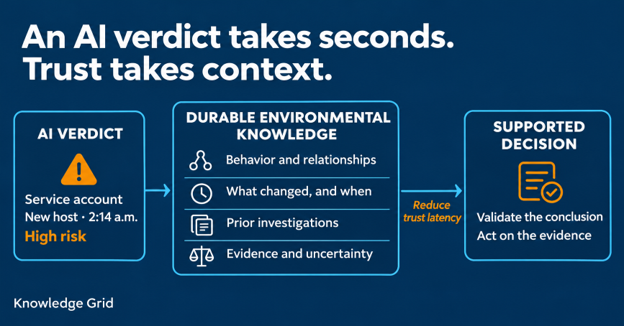
An AI verdict takes seconds; trust takes context. Durable knowledge of the environment, meaning behavior and relationships, what changed and when, prior investigations, and evidence and uncertainty, is what turns a fast verdict into a supported decision and reduces trust latency.
What the term gets attached to
I have seen “knowledge layer” attached to log filters, enrichment pipelines and event tags. Those tools are useful. They decide what data reaches a model and how it is labeled.
What they do not do is tell the model what your organization already knows about its own environment. Filtering and labeling data is not the same as knowing what it means.
What an analyst checks before trusting an AI answer
That knowledge is what an experienced analyst checks before trusting an AI answer:
- How does this host normally behave?
- What changed, and when?
- Was this pattern confirmed as benign last quarter?
- Is that still true?
If the AI cannot answer those questions for itself, a person has to answer them for it, every time. A knowledge layer is what lets the AI start from the answers.
Five tests for a knowledge layer
Here are the five tests I believe a knowledge layer for cybersecurity AI must pass:
- It remembers what it learned over time. What was concluded in one investigation is still there for the next, so each question starts from what is already known instead of from raw logs.
- It knows each entity's normal behavior across many attributes at once. Not one baseline per field, but which combinations of attributes are normal for each user, host and service.
- It attaches evidence to every result. Every answer shows what it is based on, so a person can check it rather than take it on faith.
- It corrects and retires facts that stop being true. When a host is rebuilt or a pattern is no longer benign, the old fact is updated or retired, not left in place to mislead.
- It serves analysts, detections and agents without rebuilding context each time. The same knowledge is available to every consumer, instead of each one reassembling it from scratch for every question.
The measure that matters: trust latency
In this context, the measure that matters is something I call trust latency: the delay between a machine reaching a conclusion and a person confirming it is right, so it can be acted on.
An AI that reaches a conclusion in seconds does not help much if it takes an analyst an hour to confirm it. A knowledge layer that passes the five tests should shorten that delay, because the answer arrives with the history, the evidence and the context a person would otherwise go and find.
Questions to ask any vendor that uses the term, us included
If a vendor says it has a knowledge layer, these questions turn the five tests into a conversation:
- What does it remember from one investigation to the next, and where is that kept?
- How does it learn normal behavior: one attribute at a time, or combinations of attributes for each entity?
- Can you show me the evidence behind this specific result?
- What happens to a fact when it stops being true? Can you show me one that was corrected or retired?
- Do analysts, detections and agents draw on the same knowledge, or does each rebuild its own context?
- How would we measure trust latency before and after we deploy it?
Ask them of us too. They are the questions we hold ourselves to.
Where Knowledge Grid fits
Knowledge Grid builds the knowledge layer for cybersecurity AI. Our Cognitive Data Layer turns security telemetry into structured, time-aware knowledge at ingest. Knowledge-Grounded Anomaly Detection (KGAD) learns which combinations of attributes define normal for each entity and attaches evidence to every finding. The Durable Memory Layer keeps what has been learned so it is not rebuilt for every question.
If you want to see where your own environment stands, the Blind Spot Scan starts with five questions of its own.