What is trust latency?
Trust latency is the delay between a machine reaching a conclusion and a person confirming it is right, so it can be acted on.
AI can reach a conclusion about a security alert in seconds. Before anyone acts on it, a person still has to confirm it is right. If that check takes an hour, the AI has not saved an hour. Trust latency measures that check, and it can be where the real delay sits.
What makes trust latency long?
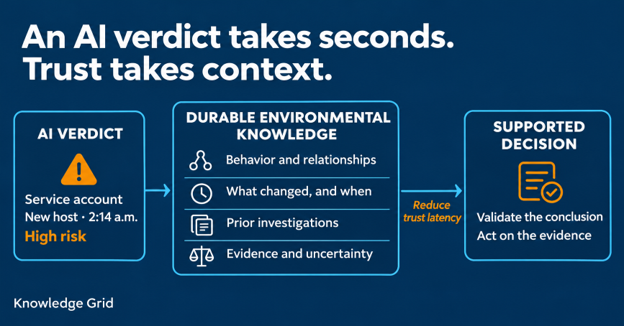
Every alert has to be checked before anyone acts. Thin context makes that check longer, because the analyst has to find out for themselves what the machine did not know:
- How does this host or account normally behave?
- What changed, and when?
- Was this pattern confirmed as benign before?
- Is that still true?
When those answers live in people's heads rather than in the data, every conclusion is rechecked from scratch, and the knowledge leaves when the people do.
How do you measure trust latency?
For each finding, record when the machine reached its conclusion.
Record when a person confirmed or rejected it.
The gap is the trust latency for that finding. Track the typical gap by type of finding.
Compare it before and after a change, such as new data sources or a knowledge layer.
The 90-Day Evaluation Program readout reports the trust latency for each finding: how long it took your team to confirm it was right.
How does a knowledge layer reduce trust latency?
A conclusion is faster to confirm when it arrives with the history, the evidence and the context a person would otherwise go and find. That is what a knowledge layer for cybersecurity AI is for. In What Is a Knowledge Layer for Cybersecurity AI? Five Tests, Peter Bybee sets out what one must do: remember what it learned, know each entity's normal behavior across many attributes at once, attach evidence to every result, correct and retire facts that stop being true, and serve analysts, detections and agents without rebuilding context each time.
Knowledge Grid's Cognitive Data Layer is built to do this, and KGAD attaches evidence to every finding.
Trust latency questions, answered
What is trust latency?
Trust latency is the delay between a machine reaching a conclusion and a person confirming it is right, so it can be acted on.
Is trust latency the same as MTTR or dwell time?
No. Mean time to respond and dwell time measure how long a threat goes unresolved or unnoticed. Trust latency measures one step inside that: the time between a machine's conclusion and a person confirming it is right. A security team can detect quickly and still lose hours at that step.
How do you reduce trust latency?
Give the conclusion the context a person would otherwise go and find: how the entity normally behaves, what changed and when, what earlier investigations concluded, and the evidence behind the result. A knowledge layer that remembers, keeps facts current and attaches evidence shortens the check.
How do you measure trust latency?
For each finding, record when the machine reached its conclusion and when a person confirmed or rejected it. The gap is the trust latency for that finding. Track the typical gap by type of finding, and compare it before and after a change.
How long does it take your team to trust an alert?
The Blind Spot Scan asks exactly that, along with four other questions, and points you to the scan option that fits.